

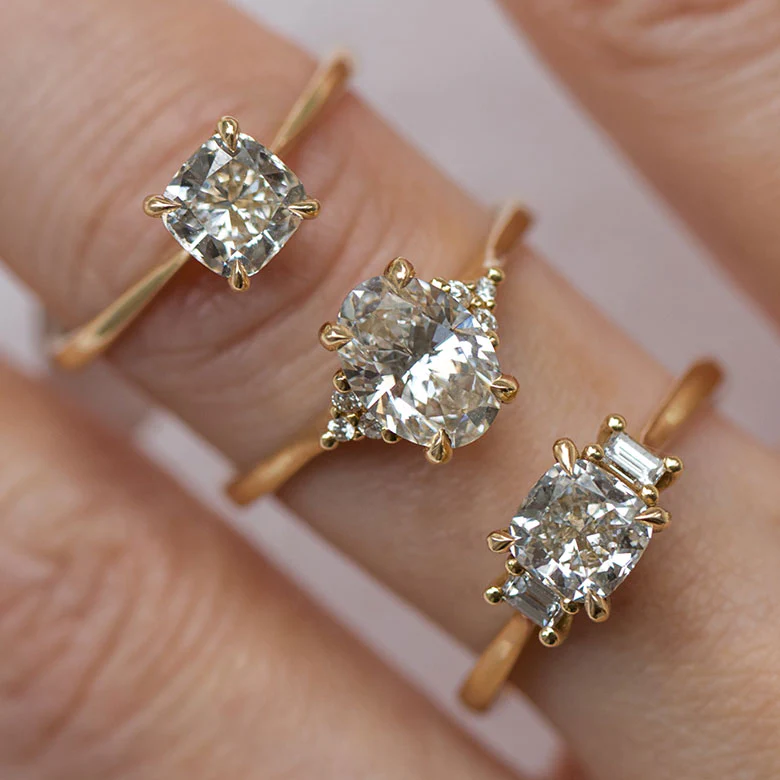
Some diamond shapes are defined by geometry; others are remembered for how they make you feel. The elongated cushion cut manages both. Its softly rounded corners convey romance, while its lengthened outline gives the stone a poised, contemporary character. It is distinctive without appearing unconventional—an appealing balance for an engagement ring intended to be worn for decades.
Exploring elongated cushion diamonds by Lily Arkwright reveals how naturally this shape adapts to different aesthetics, from pared-back solitaires to diamond-set shoulders, hidden halos and more decorative settings. The cut’s combination of softness, brilliance and visual presence explains why it has become such a compelling alternative to traditional round, oval and square cushion diamonds.
What Defines an Elongated Cushion Shape?
A traditional cushion-cut diamond is generally square or close to square, with curved corners and gently bowed sides. An elongated cushion retains those characteristic soft edges but extends the stone’s length, creating a rectangular silhouette.
The degree of elongation is expressed through the diamond’s length-to-width ratio. A ratio around 1.15 offers a subtle stretch, preserving much of the classic cushion appearance. Ratios approaching 1.25 or 1.30 create a noticeably longer profile. Neither is inherently superior; the choice depends on whether the wearer prefers a softly proportioned cushion or a more pronounced, elegant rectangle.
This elongated outline can also flatter the hand. Because the eye follows the diamond vertically along the finger, the shape may create an impression of length and refinement. Its spread can make it appear visually substantial for its carat weight, although actual face-up size will still depend on the individual stone’s measurements and depth.
How the Facets Influence Brilliance
Elongated cushion cuts belong to the brilliant-cut family, but their sparkle is not identical to that of a round brilliant diamond. Rather than producing a highly uniform pattern of small flashes, a cushion may display a mixture of broad reflections, lively scintillation and softer pools of light.
Facet arrangements vary between stones. Some elongated cushions have larger, more defined facets that create bold flashes as the diamond moves. Others feature additional facets beneath the surface, producing a more intricate, splintered sparkle often described as a “crushed ice” effect.
Preference is personal. Larger facets can feel crisp, romantic and slightly vintage, while a crushed-ice pattern delivers continuous shimmer and a distinctly modern energy. Videos and in-person viewing are particularly valuable because grading reports do not fully communicate how a diamond handles light.
Choosing Proportions, Carat Weight and Setting
Carat weight measures mass, not visible size. Two elongated cushion diamonds of the same weight can therefore look different once set. A shallower, well-proportioned stone may present a broader face-up area, while a deeper diamond can carry more of its weight below the setting.
This is also why someone might prefer a two-carat elongated cushion over a one-carat stone for reasons beyond scale. The larger surface can make the facet pattern easier to appreciate and give a solitaire greater architectural presence. Conversely, a one-carat centre stone may feel more balanced on a slender band, suit an understated personal style and prove easier to wear every day.
Setting choice further changes the diamond’s personality. A solitaire places the emphasis firmly on shape and symmetry. Pavé shoulders add brilliance without disguising the outline, while a hidden halo introduces detail beneath the centre stone. A conventional halo creates a fuller, more decorative appearance. Platinum and white gold produce a cool, seamless look; yellow or rose gold offers warmer contrast around the diamond. The Lily Arkwright collection presents elongated cushion lab diamonds across these setting and metal options.
Why Lab-Grown Suits This Cut
Lab-grown diamonds possess the same essential optical and physical characteristics as mined diamonds. Their value proposition can allow buyers to prioritise a larger carat weight, stronger colour grade or higher clarity while remaining within a considered budget.
For an elongated cushion, that flexibility is useful. The cut rewards careful comparison: outline, facet pattern, light performance and overall visual balance can matter more than pursuing one specification in isolation. An independently graded stone provides important information, but the most convincing choice will be the diamond whose proportions and sparkle work harmoniously together.
Final Thought
An elongated cushion-cut lab diamond combines the familiarity of a classic cushion with the elegance of a lengthened silhouette. Its rounded corners soften the design, while its brilliant faceting gives every stone an individual play of light. Rather than selecting by carat weight alone, consider ratio, face-up dimensions, facet character and setting as parts of one composition. The right diamond should not simply meet a list of grades—it should look beautifully balanced each time it catches the light.





Leave a Reply